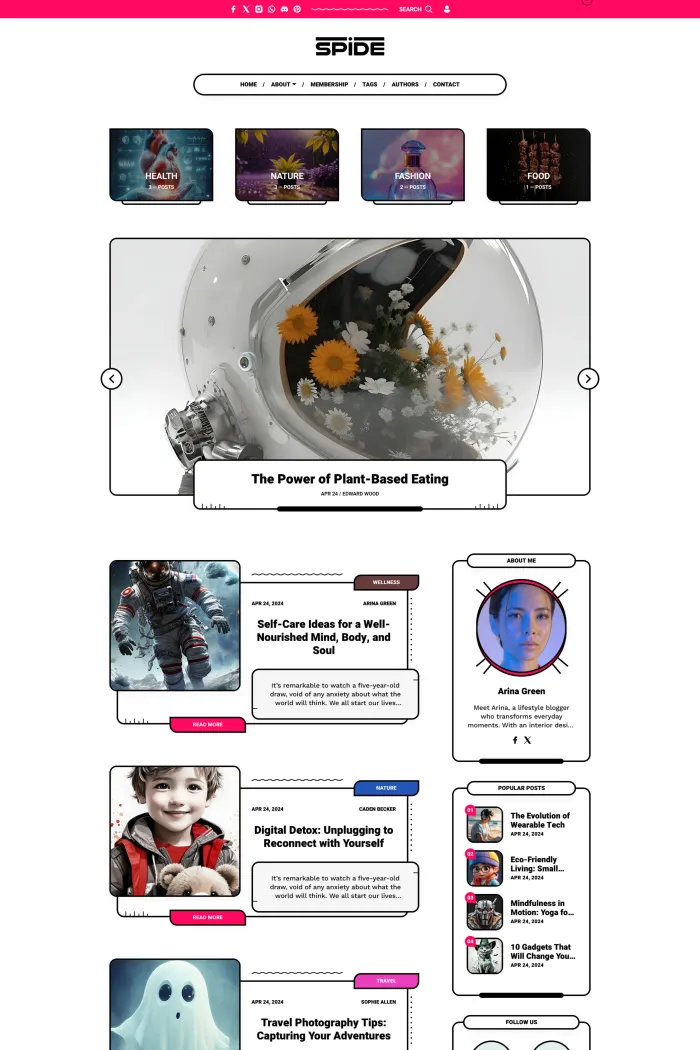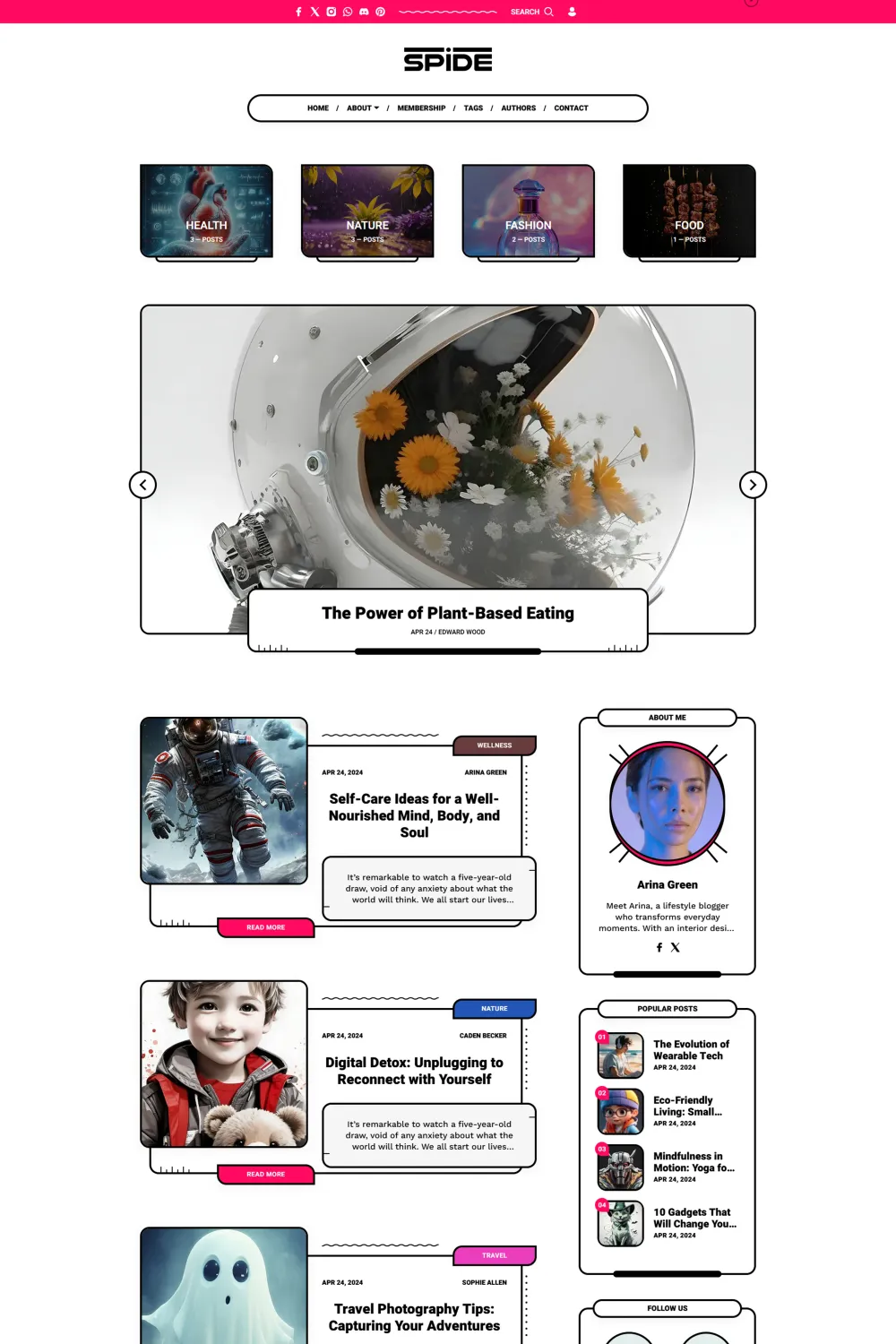

A clean layout alone does not justify a premium Ghost theme anymore. That is exactly my problem with Spide. On the surface, it looks like a usable Ghost magazine theme for bloggers, writers, and editors. But once I checked the ThemeForest listing, the live demo, the developer site, and your performance notes, I came away disappointed. For $99, I expect stronger differentiation, better accessibility, and public documentation I can inspect before buying.
Frenify presents itself as a web product company founded in 2017 by two friends, focused on quality and a wide range of products from templates to themes and plugins. On its Ghost-theme marketing pages, it talks about professional designs, responsive layouts, and performance optimization. That brand positioning sounds good, but Spide itself does not give me enough verified substance to match that pitch.
TL;DR — Key takeaways
- Spide is a blog and magazine Ghost theme priced at $99, with support for Ghost 6.x.x and 5.x.x on its ThemeForest listing.
- The demo does show a usable editorial structure: search, Membership, Tags, Authors, Contact, category browsing, sidebar widgets, social links, and newsletter signup.
- The biggest red flag is accessibility. Your supplied test notes say ADA/WCAG: Not Compliant, 59%, with 53 issues, including contrast failures and many links without discernible text.
- I could not verify any public documentation link before purchase, even though the ThemeForest page labels the item “Well Documented.” That hurts trust and setup confidence.
- I do not recommend this theme. The design is serviceable, but the value, accessibility profile, and lack of public docs make it hard for me to justify.
SEO keywords
Ghost magazine theme, blog and magazine Ghost theme, responsive Ghost theme, Ghost theme for writers, Ghost theme for bloggers, editorial Ghost theme, magazine Ghost layout, membership Ghost theme, sidebar Ghost theme, premium Ghost magazine theme
What makes Spide unique?
Honestly, Spide’s main differentiator looks more visual than functional. What I can verify is a clean editorial homepage, category-led browsing, sidebar widgets, and membership-related pages in the demo. I do not see a clearly documented standout feature that separates it from stronger Ghost magazine themes in the same price bracket.
Theme overview
Spide is listed on ThemeForest as “Spide - Blog & Magazine Ghost Theme” by Frenify. The listing describes it as a premium theme for bloggers, writers, and editors, and confirms responsive layout, 4+ columns, high resolution, included HBS/CSS/JS files, future updates, and 6 months support under the regular license. It also lists compatibility with Ghost 6.x.x and 5.x.x.
From the demo alone, I can confirm a classic magazine-style front page with topic groupings, featured post cards, author names, dates, excerpts, and “Read More” CTAs. The visible navigation includes Home, About, Terms & Conditions, Privacy Policy, Membership, Tags, Authors, and Contact, which gives the theme a fairly standard content-publication structure.
I can also see sidebar-style utility blocks such as About Me, Popular Posts, Follow Us, Categories, and a newsletter area labeled “Stay in the loop.” One previewed post also shows subscriber-only messaging, which suggests the theme is built to present membership-gated content cleanly. These are useful pieces, but they still feel like baseline Ghost magazine features rather than premium differentiation.
Top features of Spide
- Ghost compatibility: ThemeForest lists support for Ghost 6.x.x and 5.x.x.
- Responsive magazine layout: The listing explicitly marks the layout as responsive and built with 4+ columns.
- Editorial front page: The demo shows category-led content blocks, article cards, dates, authors, excerpts, and “Read More” links.
- Membership-related navigation: The live preview includes a visible Membership page link.
- Subscriber-only content presentation: At least one demo post displays a subscriber-only message.
- Search, tags, authors, and contact pages: These are all visible in the demo navigation.
- Sidebar widgets: The demo shows About Me, Popular Posts, Follow Us, and Categories blocks.
- Newsletter signup section: The demo includes a “Stay in the loop” email signup block.
- ThemeForest package basics: The listing includes future updates and 6 months support.
Pros & cons
Pros
- The overall structure is familiar and usable for a magazine Ghost theme. I can see category navigation, article cards, author bylines, and supporting widgets without hunting for them.
- The demo includes the basics many publishers want: search, membership, tags, authors, contact, newsletter signup, and sidebar content areas.
- ThemeForest confirms current-enough platform support with Ghost 6.x.x and 5.x.x, plus future updates and bundled support.
- Your supplied PSI brief gives it 94 Accessibility, 100 Best Practices, and 92 SEO, which is decent on paper before I look at the broader accessibility findings.
Cons
- The accessibility picture is poor. Your ADA/WCAG brief marks it Not Compliant, 59%, with 53 issues, including 20 contrast failures, 30 links without discernible text, and landmark issues. That is a major weakness for any public-facing publication.
- I could not verify any public documentation before purchase. That matters. ThemeForest says “Well Documented,” but I could not inspect a public docs portal the way I can with stronger Ghost theme vendors.
- The $99 price feels hard to defend when I cannot verify a standout feature set or strong pre-purchase documentation.
- The design is not terrible, but I do not find it especially memorable or premium-looking compared with better-documented magazine alternatives. That is my own reading of the live demo UI.
Who is Spide ideal for?
For bloggers and writers
If you only need a clean editorial shell with a familiar magazine layout, Spide can do that. The live preview shows enough structure for a personal publication with categories, bylines, social links, and a newsletter area.
For magazine publishers
This is the use case the listing targets most directly. But this is also where I become more critical. A premium Ghost magazine theme should give me stronger proof of quality, better accessibility, and clearer setup guidance. Spide does not give me enough confidence there.
For membership-driven sites
The demo does show membership navigation and subscriber-only preview messaging, so I can see the appeal for publishers who want gated content. Still, I would rather choose a theme with clearer documentation and a stronger accessibility profile before building a paid content business on top of it.
Performance, accessibility & SEO
On the raw PageSpeed-style summary you supplied, Spide looks acceptable: Accessibility 94, Best Practices 100, and SEO 92. Those numbers are not disastrous. In isolation, they might even look respectable for a responsive Ghost theme.
But the ADA/WCAG numbers are where this review falls apart for me. 59% with 53 issues is not a small edge case. The biggest problems you supplied are low contrast and missing discernible link text, which directly affect usability for real readers. For a publishing theme, that is a serious weakness, not a minor technical footnote.
SEO is not hopeless here, but I would not call it a standout. A 92 SEO score is workable, and the demo does show structured content areas like categories, authors, and tag browsing. Still, I cannot ignore that accessibility and documentation both drag down the overall value proposition.
Installation & customization guide
This is one area where I am not willing to guess. I could not verify any public Spide documentation or public setup guide before purchase, so I am not going to invent a detailed installation walkthrough. ThemeForest labels the item “Well Documented,” but without a public manual, I cannot fact-check the real setup depth, customization options, or post-purchase onboarding quality. That missing transparency is part of why I rate the theme so poorly.
Rating & recommendation
My rating: ★☆☆☆☆ (1/5)
I do not recommend Spide. The core reason is simple: I do not see enough verified value for $99. The live demo is usable, yes. The structure is serviceable, yes. But the theme has poor ADA/WCAG results, no public documentation I can inspect, and no clearly documented standout feature that would make me choose it over stronger competitors.
If someone absolutely loves this exact visual style, they may still be tempted. I would still push back. At this price, I want a better balance of design, accessibility, documentation, and confidence. Spide does not give me that balance.
FAQs
Is Spide compatible with Ghost 6?
Yes. The ThemeForest listing says Spide supports Ghost 6.x.x and Ghost 5.x.x.
Does Spide include membership-related pages?
The demo navigation includes a Membership page, and the preview also shows a subscriber-only message on at least one post.
What can I verify from the live preview?
I can verify search, tags, authors, contact, category browsing, social links, an About Me block, Popular Posts, Follow Us, Categories, newsletter signup, and older-post pagination.
Is there public documentation for Spide?
I could not verify any public documentation link before purchase. That is one of the biggest problems I found while researching it.
Is Spide accessibility compliant?
No. Your supplied ADA/WCAG brief marks it Not Compliant, with a 59% score and 53 reported issues.
Who is Spide best suited for?
Based on the listing and demo, it is aimed at bloggers, writers, editors, and magazine-style publishers who want a clean editorial structure.
Spide alternatives
- Echo looks like a cleaner premium magazine alternative if you want featured articles and membership subscription built more clearly into the homepage concept. Even the Theme My Blog snippets frame Echo around a clean magazine layout plus subscription flow, which already feels more purpose-driven.
- Noise is the stronger pick if you want a bold editorial identity. It offers dark mode, Ghost Admin customization, hero images, logo carousels, dedicated pages for featured and members-only content, and Ghost v5+ compatibility.
- Groovy is a better all-rounder if you want speed, native search, memberships, Koenig support, syntax highlighting, translation readiness, and clearer documented setup guidance. It also positions itself as lightweight and content-focused, which makes the value proposition easier to understand.
- Tozan is easily the most convincing alternative here for magazine publishers. It has light/dark/sepia modes, flexible feed layouts, multiple post templates, configurable membership pages, native comments, tags/authors/featured archives, contact page support, and stronger documentation.
Conclusion
Spide is not unusable. That is not my issue with it. My issue is that it asks premium money while giving me too little confidence. I can verify a clean editorial layout, membership-related pages, useful sidebar blocks, and current Ghost compatibility. But I can also verify poor accessibility results, weak pre-purchase transparency, and no public documentation I can inspect. For me, that is enough to walk away.